Even homeowners aren’t safe from eviction – the case of Lesnes, Thamesmead

We need to stop thinking of home ownership as financial ownership of a property or the land and instead understand ownership in terms of how a house is lived in, the home that is made, the connections that make a household part of a community. When we shift focus from a house’s financial value to a home’s social value, we reveal what keeps being broken and destroyed by landlords, landowners and developers – even social ones supposedly offering compensation for relocation.

If you think that owning your home is a surefire way to prevent eviction and community destruction, the story of Lesnes in Thamesmead proves otherwise. Here’s a community where homeowners and social renters alike are being forced out by housing association Peabody, who plans to demolish their 1960s homes all in the name of “regeneration.”

Regeneration = evict and demolish

Lesnes was part of the larger Thamesmead estate, built in the 1960s as a “Town of Tomorrow” – a futuristic-looking mega-development meant to create liveable “forever” homes next to picturesque man-made lakes and waterways. The 600 homes in the Lesnes part are made up of six tower blocks and rows of terraced townhouses – homes which have housed families for generations.

More than a decade ago, Peabody bought the estate and in 2022 was granted planning permission to ‘regenerate’ the whole area (despite their plans showing an overall loss in “affordable” rent housing units). Regeneration as we know is often code for evict and demolish, as residents quickly discovered. Many of Thamesmead’s social housing tenants have already been shunted elsewhere, while owner occupiers in Lesnes – the majority of whom are of West African descent, many elderly – have been told they’ll be forced out through compulsory purchase … if they haven’t felt pressured to move out already.

Just like on our Coal Board estate across 2021-22, empty houses around those refusing to leave Lesnes have been boarded up and left vacant. This time by a supposedly social landlord in the midst of the housing crisis.

Fighting back in a rigged system

Residents have refused to budge. When news broke of the regeneration plans, they formed LesRes (Lesnes Resistance) and have fought back through petitions, garnering political and activist support, staging sit-ins and protest parties, getting backing from political figures and media commentators. Their arguments are familiar – keep a community together, keep residents in their local area where they have established jobs, relationships and connections, and refurbish the properties rather than taking the environmentally-costly demolition route.
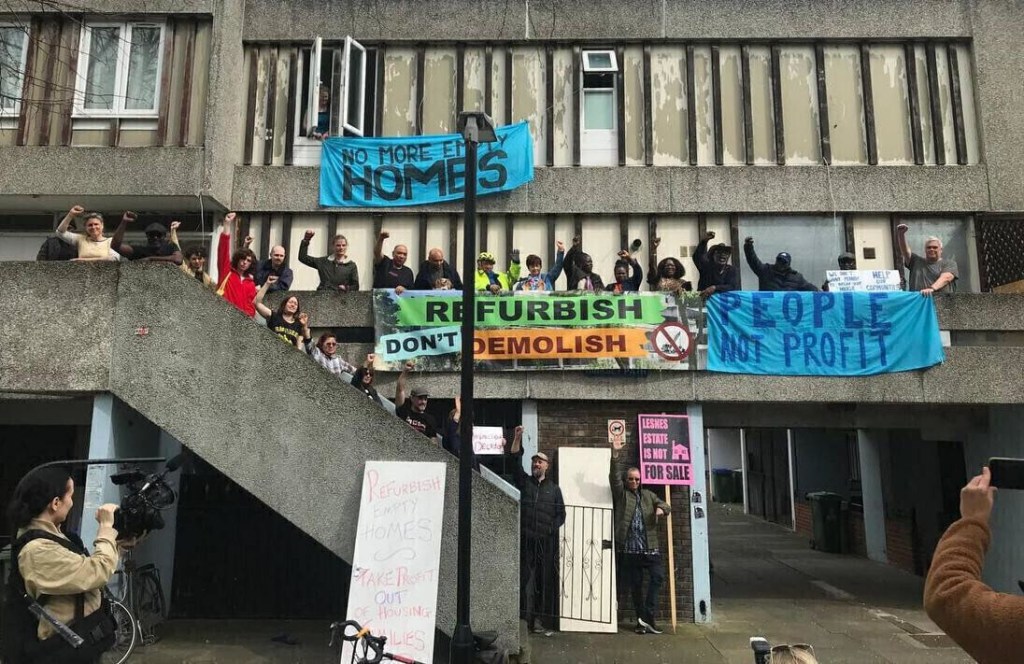
Credit: squat.net

But this is another David and Goliath fight in a rigged system. As OnLondon broke a few weeks ago, Thamesmead is being touted as one of the government’s ‘New Towns’, a flagship policy to deliver hundreds of thousands of new homes, which will require the demolition and redevelopment to go ahead. Peabody are already a fair way into their regeneration plans.

Where are the residents’ voices and needs in all of this? RealMedia spoke to residents last year, who were several years into their fight already, and they were exhausted and dejected. “It’s not good not knowing where you are going to live tomorrow”, one resident shared with journalist Sul Nowroz.

Peabody are offering to buy their homes at “market value”, but of course that value is shaped by the long-neglected state of Lesnes by various landowners and landlords over the decades. So, the offers some have received are well-below the market rate new-builds on the same land will fetch. They’re also too low to enable any of these residents to continue living in the local area – their home area.

Same old story

Yet again, people’s lives, local community networks, and their love for their homes and neighbours are viewed as completely irrelevant to wider planning priorities. Obstacles to planning, even. Just like Heygate in Southwark, just like the Aylesbury estate in Walworth, just like our Coal Board estate in Leeds. Social relationships and thriving communities broken by landowners and landlords without a second thought. Cherished, iconic homes degraded and then demolished.

This is the familiar pattern I document in my book Eviction: A Social History of Rent – for more than 150 years, ordinary renters have been seen by political leaders, housebuilders, investors, and industry as moveable masses, encouraged to make homes, then evicted and displaced in frequent cycles. State-sponsored displacement has been packaged as progress since Victorian slum clearances, demolishing communities and building “better” houses while treating tenant (and some homeowner) lives as expendable.

Why this case matters

The Lesnes story shows more than many others that there aren’t clear goodies and baddies in our eternal housing crisis. Peabody is a social landlord charging ahead with the destruction of the Lesnes community, not your usual speculator type. The residents facing eviction are homeowners as well as renters.

Such dynamics reveal the deeper truth about how our housing system actually works. Housing authorities have long treated people and houses as detached concerns, lacking the incentives or the means to keep communities together. The two-part logic that has characterised the British rental sector for over 150 years applies even to homeowners facing compulsory purchase: first, that people merely occupy properties, so their personal lives are irrelevant to what is legally someone else’s (or the state’s) planning priorities. Second, that interdependence between neighbouring homes is “just” happenstance neighbourliness rather than essential care relationships – therefore irrelevant to housing planning and management.

Honestly, every day now there seem to be more cases I should add to this record of screwed-over tenants – and now homeowners too (just like the leaseholders in the Kirkby towers from my previous blog post). The Lesnes case shows how displacement-as-progress continues to steamroll over communities, regardless of tenure type.

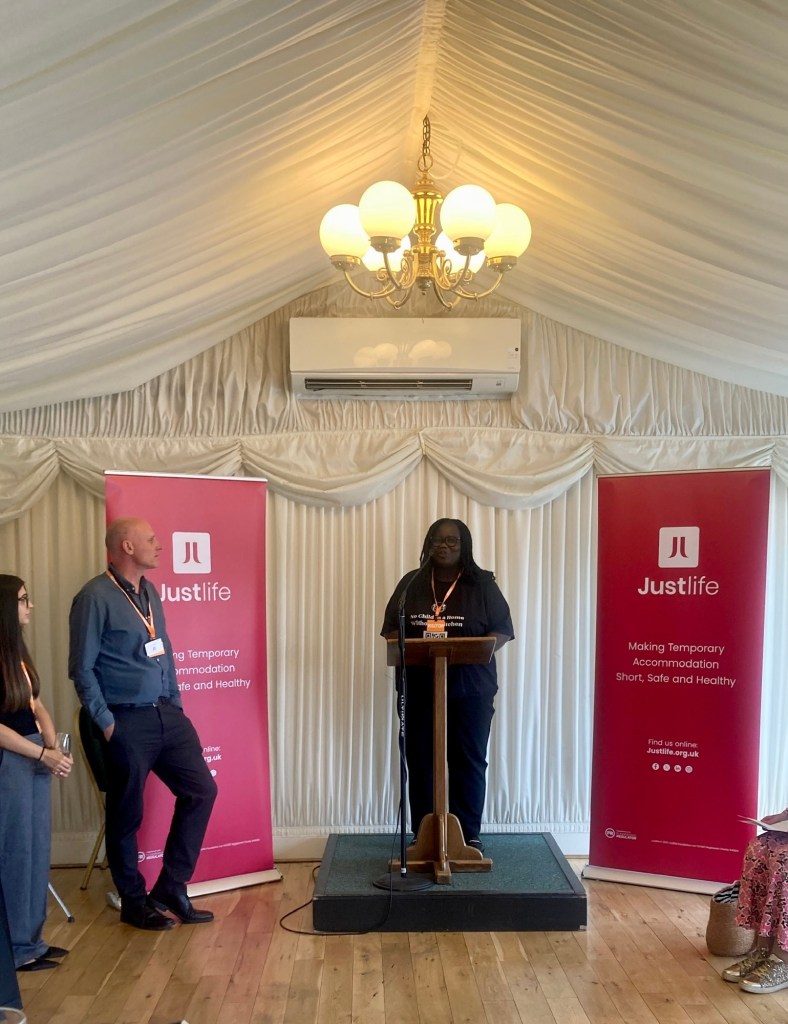
Is short, safe and healthy Temporary Accommodation too much to ask?

For my first post under the banner of our new mission to support other tenant activists and campaigns, I want to spotlight a new report that should be read by anyone worried about housing insecurity: JustLife’s A Better Vision for Temporary Accommodation’.

Temporary Accommodation is the home no one actively wants to find themselves living in, but’s the last safety net we’re entitled to if we find ourselves suddenly evicted and homeless. So, we all have a stake in making it decent and dignified.

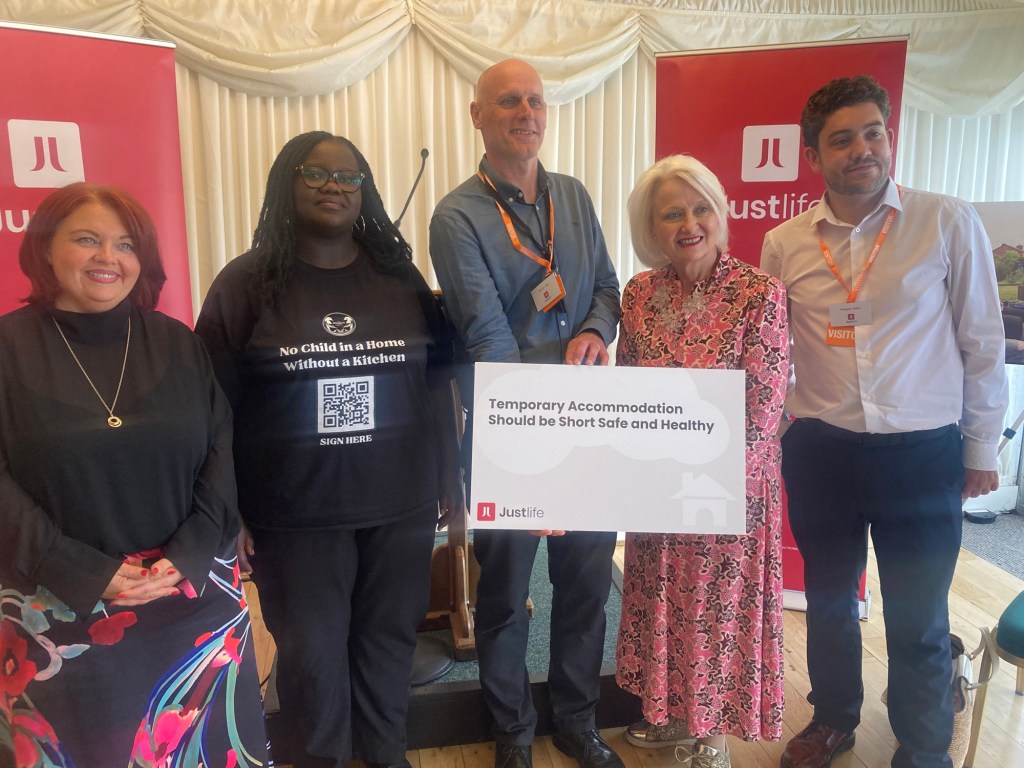
On Monday, I was lucky enough to attend the Westminster launch event for this report and hear the inspirational lineup of speakers outline the urgency of the change needed to protect homeless individuals and families. 

Many MPs were present at the event, including the Paula Barker, Labour MP for Liverpool Wavertree, Siobhain McDonagh, Labour MP for Mitcham and Morden and Chair of the APPG for TA, which was great to see. They’re committed to advocating on behalf of families stuck in TA everywhere, and stated they’ll take Better Vision’s recommendations back to the government – meaningful change now needs to follow.

Here’s all you need to know about the event and report:

Who are JustLife?

JustLife provides healthcare, housing and wellbeing support for people who find themselves having to live in temporary accommodation in Manchester and Brighton. It’s also a nationwide learning and advocacy organisation promoting the (apparently not obvious) need to make temporary accommodation short, safe, and healthy. 

If you haven’t heard of JustLife before now, that’s probably because you’ve not been faced with living in what passes for Temporary Accommodation (TA) in this country. TA lodgings can be private rental or local authority flats or houses, B&B rooms, hostel rooms, refuges. They are run by a diverse bunch of landlords – council, private and charity – and they’re often bottom of the priority list for maintenance so are in a varied state of disrepair.

TA life and numbers

Some of the conditions that speakers drew attention to in Monday’s event are just horrendous: chronic damp and mould, shared rooms with shared beds, no privacy, no kitchen, and no play or homework space for children. 

When I was researching for my book Eviction, I learned that 279,390 people were living in TA by the end of 2023 – pretty much equivalent to the entire population of the city of Nottingham. The majority two-thirds of these statutorily homeless people are women. And one of the main reasons women end up in TA is because of domestic violence, followed closely by eviction. Many women flee with children, and many other TA households are made homeless as family units; Better Vision highlights that today, 164,000 children are living in TA (up 15% in a year).

It was only last year (!) that the government updated guidance to state that cots should be given for homeless families with children under two (a change achieved by advocacy from JustLife, Shared Health and others). 

As a recent mum myself, I remember safe sleeping arrangements (i.e. cots, separate space, firm mattress) being drummed into me as a parental care essential from well before my little one was born. It’s listed as one of the safety and care basics alongside feeding and comforting your child. The fact that it took until 2024 for the government to recommend the provision of cots as standard part of a homeless family’s emergency housing package is pretty appalling. (And, I think, a reflection of how few people with experience of TA get to feed into policy-making around TA amenities).

Leeds TA Stats
According to government data, between October and December 2024 there were 670 people in TA in Leeds .
Shelter’s research of a ‘snapshot’ of homelessness on one day in Leeds in December 2024, put that number at 806, with 379 homeless children. 

One of the key takeaways from the day was also that the suffering of families in TA is far from temporary. Many end up living in these conditions for years – that’s if they’re not packed off to ‘Out of Area’ placements, torn away from community networks. And the negative impacts of these circumstances can be lifelong.

Lack of cooking facilities and safe play spaces means that children living in TA are suffering from rickets, tooth decay and development delays, as well as severe mental health problems. JustLife’s report highlights that at least 74 child deaths can be linked to unsafe and unsanitary TA since 2019. How many of those individual stories have we seen in the news? How many have led to systemic change in how local authorities provide for homeless families with children? There’s a reason people living in TA are called the ‘hidden homeless’.

JustLife’s Better Vision

The Better Vision report, overviewed by author Morgan Tebbs, presents a range of holistic solutions that sit under four pillars: 

  1. Increase the supply of affordable housing
  2. Prevent future and repeat homelessness
  3. Improve standards in TA
  4. Provide better support for homeless households 

It’s deliberately wide because so much of what’s needed to make TA short, safe, and healthy has to come from departments and actors beyond a single landlord. The recommendations won’t be new to the housing insecure, though… many speak to key issues we and others have raised for years, including:

  • Create more genuinely affordable homes and stop selling off social and council houses – end Right to Buy! This really doesn’t need explaining.
  • Commission research into rent control. As we’ve raised here time and again, private sector rents shouldn’t be allowed to just spiral upwards, well beyond renters’ incomes. High rents force people out of their homes and into TA or the streets.
  • Apply the Decent Homes Standard to temporary accommodation (because some landlords need to be forced to apply minimum health and safety standards to TA). Under the Renters Rights Bill, this standard will finally apply to private rental sector homes as well as social – it’s unacceptable that TA is left off that list. 
  • Improve coordination between councils who are inadvertently switching homeless families through Out of Area placements (yes, that’s right, two councils sending and receiving similar numbers of homeless families moved about like chess pieces).
  • Increase the number of housing officers in councils to improve officer caseload numbers (reducing it to a number in the 10s, rather than literally unmanageable caseload of 100s – Morgan spoke of one London council giving an officer around 300 cases to manage) and enhance their training to better deal with trauma-affected people.

There are many more great recommendations in the report, as well as important testimonies of interviewees with lived experience of TA, so do give it a read and support their calls for change.

Activist Women

I recommend checking out the amazing work of the Magpie Project, too. The Magpie Project are an inspirational group of women in London’s Newham, working hard to make sure pre-school children and their mums have somewhere safe and fun to play and grow while in TA. 

Magpie’s Change and Advocacy Lead, Gifty Amponsah, was at the event and gave an impassioned and deeply personal speech about the organisation’s current campaign for ‘No Child in a Home Without a Kitchen’.

Too many families, Gifty explained, are placed in hostels without cooking facilities, causing nutritional and developmental crises in children that affect them for the rest of their lives. It should be a basic right for a child to have the comfort and nutrition of a home cooked meal – as Gifty says, this is about supporting the emotional needs met by family cooking and eating, as well as nutritional needs. Read more about their vital work and consider donating, here: https://themagpieproject.org/about/, and you can sign their petition.

Congratulations to all at JustLife – especially Simon Gale, CEO, Christa Maciver, Director of Campaigns & Social Change, and Morgan Tebbs, Influencing Coordinator – for such excellent speeches and the successful launch of an important report (and thank you for including me in the event!).

I hope Better Vision has the impact that people living in TA deserve.

~ Jess

‘Going home’ – Save Our Homes LS26 residents move into new houses

Seven and a half years after the Save Our Homes LS26 campaign began, and three years since we lost our fight against Pemberstone’s redevelopment, ex-residents of Wordsworth Drive and Sugar Hill Close have finally begun moving back and resettling into the cherished estate.

New homes for the regulated, ex-miner tenants. Photo: Mavis Abbey.

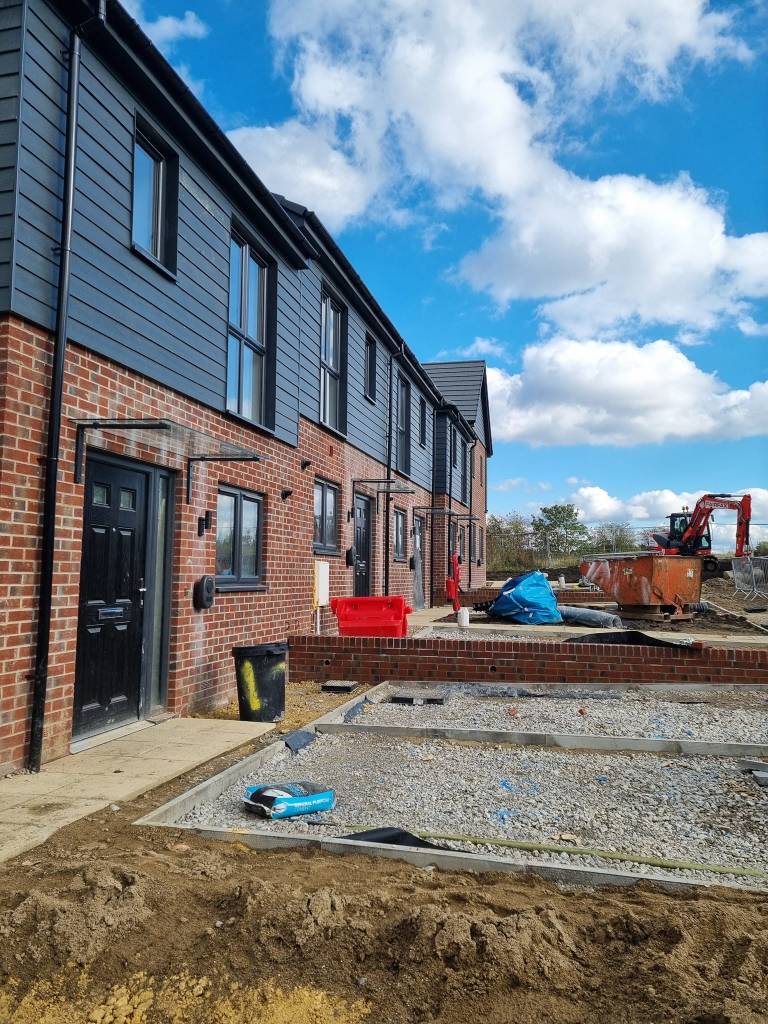
It looks a little different now. The new houses are shiny and modern-looking, with red brick wrapped around the ground floors, panel-clad first floors, large feature windows, and accentuated doorways. They’re built to high energy efficiency standards with solar panels, car chargers, and a level of insulation that will feel alien to anyone used to living in a draughty Airey prefab.

It’s not just the houses that have changed. Wordsworth Drive and Sugar Hill Close are joined by four new streets: Airey Mews, Colliers Walk, Newmarket Chase, and Water Haigh End… all nods towards the estate’s coal mining and prefab housing past.

As you’ll remember from previous updates, these new homes have been built by non-profit Leeds Federated Housing Association, who’ll now manage them as ‘affordable’ social rents. Leeds Fed’s purchase of the estate from Pemberstone in 2022 was due in no small part to our high-profile campaign to prevent eviction. And since taking over, Leeds Fed have worked harder than your typical house builder to keep residents notified of development progress: communicating directly with the ex-miner tenants who hold regulated tenancies, engaging with the ex-shorthold tenants through Save Our Homes LS26 Chair Cindy Readman, hosting a groundbreaking ceremony to mark the start of development, and even launching a microsite to cover every twist and turn of the construction and rehousing process.

This just goes to show what community mobilisation and campaign pressure can achieve! It might not have saved the community from eviction and our Airey homes from demolition, but small wins matter. Being able to return is a BIG DEAL.

Rebuilding a community

Leeds Fed and ex-miner tenants mark the completion of the first ten homes. Image: Leeds Fed Press Release Dec 2024

Retired miner residents, like Mavis and Barry Abbey, moved in first, shortly before Christmas. These ten households had pre-1988 regulated tenancy agreements with stronger rights, so they were able to stay in their Airey homes while the rest of the estate was demolished and rebuilt around them. Some couldn’t wait to jump ship and get settled in the modern new housing stock. For others, the transition has been a mixed experience.

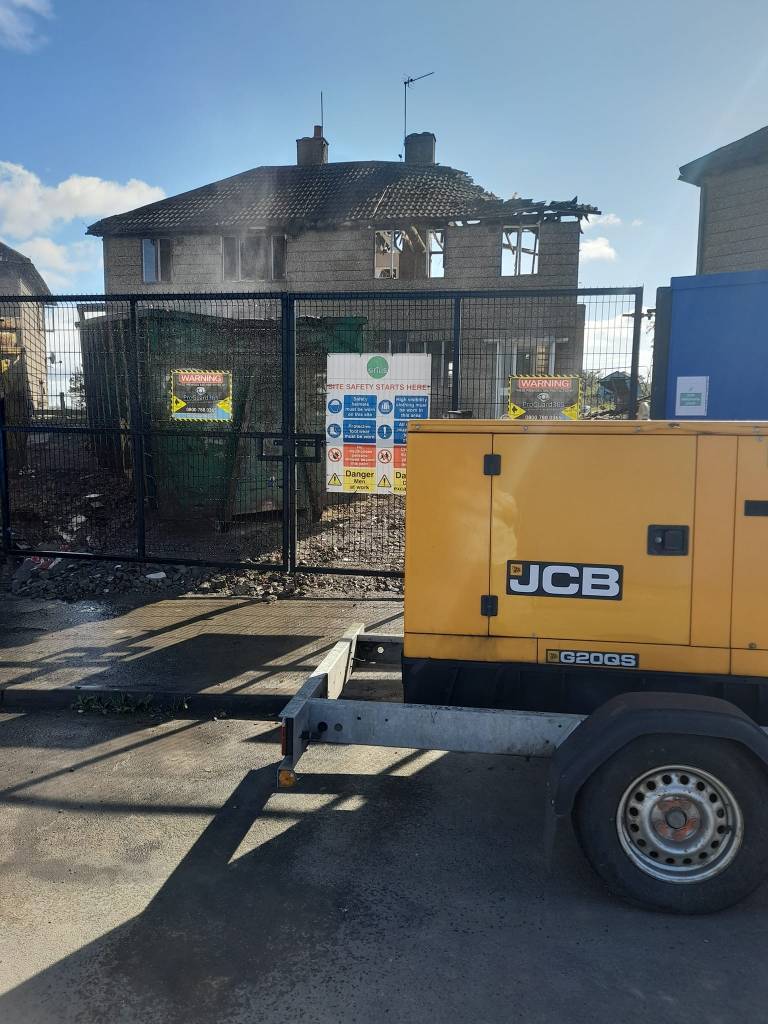
The last few years living on a building site have certainly been difficult, with workmen, fly-tippers and occasional thieves lurking about. More than once residents have been hemmed in by construction vehicles or dug up roads. Watching this historic prefab estate – beloved by generations of coal board families – being demolished bit-by-bit has also been emotionally hard.

Mavis has visually documented the redevelopment over three long years:

The end of the Abbey home. January 2025.

Mavis called it ‘the beginning of the end of an era’, as she saw her own home being knocked down by bulldozers in January.

She and Barry have lived on the estate for fifty-five years, and in this most recent Airey home since 1990. The Abbeys are trying hard to resettle in their shiny new house, but the move has come with all the usual challenges: redirecting mail (to addresses that don’t yet officially exist!), re-establishing utilities and internet connections, unpacking and working out how to fit everything into a smaller space.

The first ex-assured shorthold tenants finally began moving onto the estate this month, too. Save Our Homes LS26 Chair Cindy Readman was one of those movers and reflected on the ups and downs of the last few years when she and John picked up their keys last week:

We fought a hard campaign eventually working with Leeds City Council to secure a Housing Association buying the land. Unfortunately we had to move away for 3 years and have watched our family home demolished and the new houses being built. Today we were given the keys to our brand new home and will be moving in on Friday.

It’s been a long hard battle and we’ve made life long friends along the way. Some of our community will be returning too and we will rebuild our lovely community.

It’s just so lovely to know on Friday we will he going home.

Cindy and John Readman move into their home after a three-year wait. Photo: Cindy Readman.

Cindy has done such an amazing job liaising with Leeds Fed and Leeds City Council about the development and keeping ex-shorthold tenants informed of progress despite everyone being evicted and dispersed far and wide. She and Mavis have kept the generations of residents engaged and informed about this new chapter for Wordsworth Drive and Sugar Hill Close – thank you!

All the best to the Abbeys, Readmans and everyone else currently settling in as you all unpack and reconnect with special neighbours. Those not able to move back will no doubt pop round for a cuppa (and a guided tour) soon!

More photos and updates to follow. Watch this space!