The history of our estate is a rich one, with the development of houses and a close-knit working-class community closely interlinked with the development of coal mining in the region.
The full history of the estate, and of National Coal Board housing more broadly, can be found in Jessica Field’s forthcoming book, Eviction: A Social History of Rent (published 16 September 2025). For in-depth local history of Oulton, Woodlesford and Rothwell, visit Howard Benson’s website: https://newwoodlesford.xyz.
A brief overview:
In the 19th century, the local area was dominated by the Blayds/Calverley family who lived at Oulton Hall. They were rich cloth merchants and bankers who moved out to rural south Leeds to establish a country estate. In the process, they acquired the freehold of much of the land in Oulton, Woodlesford and Rothwell and built Oulton Hall, now a spa hotel. While the area was well-known for sandstone quarrying, the coal found under the land brought significant additional wealth to the Calverley dynasty.
In the 1950s, descendants of the Calverley family sold a parcel of land in Oulton to the National Coal Board (NCB), as coal production was nationalised by the post-war Labour government in 1947. This land was the soon-to-be site of our Oulton estate.
The estate’s streets – Oulton Drive, Shelley Crescent, Wordsworth Drive, and Sugar Hill Close – were covenanted for “dwellinghouses.” In 1953, the NCB began construction of 210 new homes, all to service nearby mines including Fanny Pit and Water Haigh Colliery. The estate rapidly filled with miners and their families (for more excellent local history on this and other topics, see Howard Benson’s website: see http://newwoodlesford.xyz/).

A local design
The miners’ shiny new homes were partial “prefabs” (or prefabricated houses), built in the Airey design and named after Sir Edwin Airey, a Leeds-born construction magnate and one-time Lord Mayor of Leeds. Airey had prototyped prefabs since the 1920s; he was so taken with the design and manufacturing method that he thought bricks would eventually be obsolete.
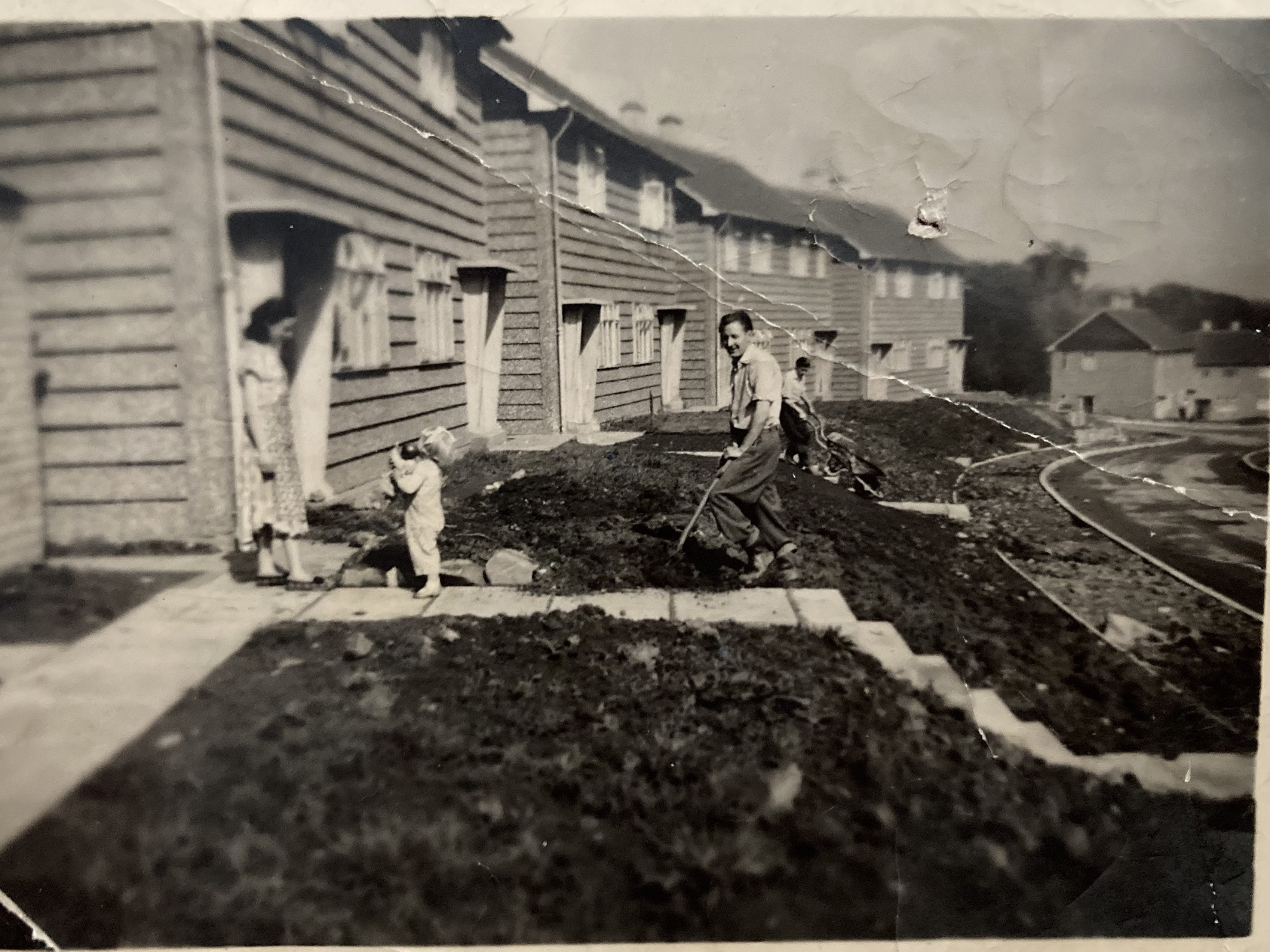
Airey houses were not fully prefabricated, like some of the temporary houses built in the early years after the war, but they gained the prefab moniker as they were partially factory made, then shipped to site and put up by unskilled labour in just a couple of weeks. (In fact, it was the draughty nature of these prefabricated constructions that caused meanspirited locals to refer to the estate as ‘Cardboard City’. Many ex-residents now use the term with affection and pride – though some still understandably hate the label).


Airey houses under construction on the Oulton estate. Photos kindly provided by the E.R. Manley collection, http://www.leodis.net.
Airey houses and other prefab types sprung up in significant numbers across the country after the war, as there was an urgent need for an expanded housing stock and a shortage of traditional building materials. The first prototype for an Airey house was built in Seacroft, a suburb of Leeds, and, between 1945 and 1955, over 26,000 were built across England and Wales – primarily in the north and midlands.
The families that moved into NCB Airey homes across the 1950s remember them fondly. Many recall siblings born in the front rooms, local tradesmen who visited the estate peddling their wares, and neighbours supporting neighbours with errands and chores – through happy and hard times. Two local women got a bus service started – the ‘Red Devil’ as it was colloquially known – to make sure kids could get to school and adults could travel further for shops and work.
Declared defective
Originally built with a ‘technical guarantee’ of sixty years, Airey homes have proven themselves to be robust and comfortable houses – particularly when refurbished in a timely manner. They are not without design flaws, though. Material faults were identified in a number of samples inspected in the early 1980s, leading to Airey and other partial prefab houses being listed as having serious defects under the 1984 Housing Defects Act.
Over the years, many have cited this Act as “proof” the buildings are flawed and only fit for demolition. However, faults were not found in all Airey houses inspected, and even those with flaws could be brought up to standard through refurbishment. Moreover, the 1984 Housing Defects Act was passed to give financial assistance to Airey homeowners who needed to repair their properties. It was not a declaration of prefab obsolescence. Many refurbished Airey homes survive to the present day, most of which have been brought up to modern standards at a relatively little cost – some for less than £10,000 per house by local housing associations and councils.
Nonetheless, on our LS26 estate, the discovery of defects in some Airey houses in the 1980s scuppered all residents’ hopes of housing security for many decades to come.
No right to buy
The local paper, the Rothwell Advertiser, explained that in the early 1980s: ‘The Coal Board wrote to every tenant when they were selling the estate, inviting them to buy their own home but… they [the tenants] then received letters advising them that the structures were faulty.
Other residents during the 1980s also remember being prevented from purchasing, or getting mortgages and insurance, on properties they had lived in for decades. Lynn and Diane’s father, Mac Dickinson, had a survey done on the house for mortgage purposes, but was refused permission to buy their home on Oulton Drive because the ‘tie bars’ (the steel structure designed to support the weight of the concrete slabs) were apparently rusting. Another resident was also informed that he would not be able to get a mortgage or insurance on his home due to rusting tie bars, despite having received notice from the NCB some years earlier that they could purchase the houses, and having since invested personally in refurbishment. A third recalled that his father was refused permission to buy their home because they were not able to get insurance, apparently due to a risk of subsidence.
Letters written in 1983 between Billy Williams, the former Water Haigh pit manager, and an NCB Area Estates Manager about a backlog of repairs on the estate noted that there was an ongoing national concern over the structural soundness of Airey houses. However, as the Estates Manager explained at the time, ‘fortunately, at present, we have not found anything [on the Oulton Drive estate] to cause concern.’
Then suddenly, by 1986, a private landlord owned the entire estate – sold right under residents’ noses. An investor developer had been allowed to purchase the estate – ostensibly, according to one ex-resident, because they bought the land, not the houses, and therefore circumvented the risk which denied residents their mortgages.
Cardboard City’s new landlord immediately hiked rent rates, yet they did no work on the houses. “Mining families living on an estate in Oulton”, the Rothwell Advertiser writes in January 1987, “are faced with either leaving or paying massive rent increases”.

A cluster of follow-up articles in the Rothwell Advertiser show that by 1989, the Oulton estate had been allowed to disintegrate into such a state of disrepair that dozens of properties had been abandoned by tenants who feared for their safety and security. Several houses had damaged windows that risked inviting squatters, and long-term residents felt forced to move elsewhere as the landlords were ignoring repeated calls for them to meet their basic repair obligations.
Just a few years later, the whole estate was then partitioned in two. Some 140 houses on Oulton Drive and Shelley Crescent were demolished, and that part of the estate was redeveloped into an upmarket housing estate.
These houses were then sold for above market prices for the area. Land registry records show that houses on Shelley Crescent sold for as much as £130,000 for some of the 4-bed detached homes on the estate – more than double the local average.
The Airey houses on Wordsworth Drive and Sugar Hill Close remained as rentals, with residents continuing to live in their un-refurbished, apparently ‘defective’ homes. Pemberstone bought the estate in 1997 and continued to run it as they found it: collecting rents and undertaking bare minimum maintenance.
Despite these ownership controversies, the original tenants – the ex-coal boarders – have remained a tight-knit community. Hundreds of coal boarders who lived there from the 1950s and 60s have kept in contact via social media long after leaving the estate and have welcomed new members and new memories as people have moved in. Many met future spouses as children in the neighbouring streets. Some still meet regularly for reunions and social lunches.
Several ex-miners and their families remained living on Wordsworth Drive and Sugar Hill Close long after the pits closed. And among the other households who have moved in since the NCB sold it in the 1980s, that community spirit and closeness remains. It’s still a low-income neighbourhood, with ex-miner pensioners mixing with manual workers, shift workers, public sector workers, and families receiving state welfare.
That’s because, while property and rental prices have skyrocketed across this south Leeds postcode, Cardboard City has remained a last holdout of affordable rents. Long may it continue.
~ By Jessica Field, daughter of ex-8 Wordsworth Drive residents Mark and Hazell.
For a longer history of the estate, check out my book: Eviction: A Social History of Rent, soon to be published by Verso.
 #SaveOurHomesLS26